
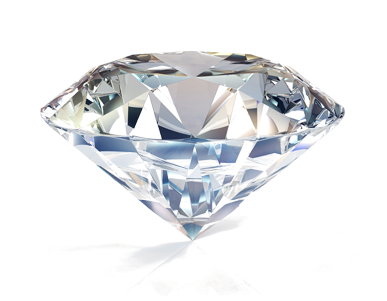
Diamond Fluorescence
Diamonds have many unique properties, including natural blue fluorescence under any source of ultraviolet light.
One technique that gemologists use to help identify and separate diamonds from the diamond look-alikes (such as moissannite and cubic zirconia) is by putting the gem under a UV lamp. If it fluoresces (glows) blue, it is almost certainly a diamond. In fact, most diamonds have some degree of fluorescence under natural light, which contains small amounts of UV frequencies.
(However, it is important to know that you cannot follow this logic in reverse and assume that when something does NOT fluoresce it must not be a diamond. Some diamonds do not have fluorescence so this logic will not work.)
How does fluorescence effect the beauty or value of a diamond? The answer to that question depends on the color grade you are buying.
First let’s talk about how it affects the beauty.
Actually, recent studies by GIA have shown that fluorescence in any amount does not impact the face up appearance of a diamond, except possibly those with extreme fluoresence (beyond the standard Very Strong grade — stones with extraordinary fluorescence are rare and were not available for testing at the time). Therefore, it is only the prevalent belief of the trade and consumers that causes less demand for stones with strong fluorescence and brings the price down.
Here is the prevalent belief system to help you understand how fluorescence influences price:
If a diamond has a color grade of J to M, a moderate amount of fluorescence will actually make a diamond more attractive to most people. Slight to moderate or even strong blue fluorescence in a stone with these color grades actually helps cancel some of the yellow and makes it looks whiter.
However, for a diamond with very high color (such as a D to F grade), fluorescence is thought to interfere with the flow of light and make the diamond appear a little oily or murky. This will not be true for most diamonds, but it is thought to be so and you can buy if for less. We still feel a little hesitant to recommend D to F color diamonds with strong fluorescence, despite the recent research. This is just because of our many years of training that we should avoid them. For this reason, we still might recommend None or Slight flourescence in colorless diamonds (D to F color grades).
In grades inbetween those above (G, H and I), it might be better to stay away from Strong fluorescence for safety’s sake, while moderate fluorescence might actually improve the color appearance in our opinion.