


Diamond Terms: I am often asked
to define diamond terms, so here is a list of the technical words
most commonly requested by our visitors, all in one place.

For a more comprehensive,
searchable glossary, visit the GIA
Diamond Dictionary
at the GIA Web site.
For brief explanations
of the specific terms used on GIA Diamond Grading Reports, visit
the page that explains the new report
formats and services.
Go here to understand
and decide
about the 4 Cs.
Go here to go beyond
the 4 Cs and learn how
to read a certificate.
Blemish:
A flaw (scratch
or abrasion) on the surface of a diamond. These are generally
not considered as crucial to the beauty of a stone if they do
not interfere with the symmetry of the shape and do not interfere
with the flow of light through the stone.
Brilliance:
White light
reflected up through the top of a diamond. Cutting a diamond
to the correct proportions increases the reflection of light
from the facets and maximizes the brilliance.
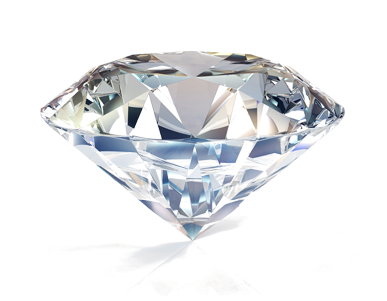
Brilliant Cut:
A 58-facet round
diamond, sometimes still called the American Brilliant. This
shape and faceting arrangement are designed for maximum brilliance,
sparkle and beauty.
Carat:
A unit of weight
for a diamond. Equivalent to 200 milligrams, or one-fifth of
a gram. In ancient India, the carob bean was used for measuring
the weight of gems, because of the rare property that every seed
weighed the same. The word "carat" today is thought
to be derived from the ancient "carob." Because they
are increasingly rare, larger diamonds cost much more than smaller
stones. Wholesale prices are listed PER CARAT to show this price
difference. For instance, a 1/2-carat round brilliant diamond
of G/VS2 quality would sell for $3,600 per carat ($1,800 for
the stone), while a 1-carat stone of the same quality would cost
$6,300 per carat ($6,300 for the stone) because it is twice the
size and more rare.
Clarity:
A grade given
to a diamond to describe the level of "impurities"
or inclusions.
Clarity grades include:
FL = Flawless -- no internal or external inclusions
of any kind visible under 10x magnification to a trained eye,
the most rare and expensive of all clarity grades
IF =
Internally Flawless -- no internal inclusions visible under 10x
magnification to a trained eye, but there may be some tiny external
irregularities in the finish
VVS-1 = Very Very Slightly Included 1 -- usually just
one tiny inclusion visible only to a trained eye under 10x magnification
VVS-2 = Very Very Slightly Included 2 -- tiny inclusions
visible only to a trained eye under 10x magnification
VS-1 = Very Slightly Included 1 -- very small inclusions
visible with 10x magnification
VS-2 = Very Slightly Included 2 -- several very small
inclusions visible with 10x magnification
SI-1 = Slightly Included 1 -- small inclusions visible
with 10x magnification
SI-2 = Slightly Included 2 -- several small inclusions
visible with 10x magnification
SI-3 = Slightly Included 3 -- inclusions that may
be visible to the naked eye for a trained observer
I-1 = Included 1 -- flaws that are visible to the
naked eye
I-2 = Included 2 -- many flaws clearly visible to
the naked eye that also decrease the brilliance
I-3 = Included 3 -- many flaws clearly visible to
the naked eye which decrease the brilliance and compromise the
structure of the diamond, making it more easily cracked or chipped
Cloud:
A cluster of
very small inclusions inside a diamond that give a cloud effect.
Tiny clouds will not interfere with the flow of light, but large
or numerous clouds can affect brilliance.
Color:
A grade given
to a diamond to describe the subtle tones of color in a stone.
D is perfectly colorless, the most rare and expensive color.
As you go from D to Z on the normal color scale, it indicates
increasing levels of yellow and/or brown tones. It takes a trained
eye under special lighting to distinguish between neighboring
color grades (such as E to F), but most people can discern the
difference between colors that are several grades apart (such
as E to H) with a little practice. Fancy colors such as pink,
red, blue and green are discovered each year, but they are very
rare and incredibly expensive. Such fancy colors do not follow
the normal color/pricing scales and are categorized separately.
The normal color scale, as defined by the Gemological Institute
of America:
D, E, F = Colorless
G, H, I, J = Near Colorless
K, L, M = Faint Yellow
N, O, P, Q, R = Very Light Yellow
S, T, U, V, W, X,
Y, Z = Light
Yellow
Culet:
A facet on the
very bottom of a diamond. It is best to have a small or medium
culet. A large culet will make it look like there is a hole in
the bottom of the stone due to leakage of light. Absence of a
culet makes the point of the diamond more easily damaged or chipped.
Cut:
Commonly used
to refer to both the shape of a stone (round, pear, oval, etc.)
and the make (the exact geometric proportions to which a diamond
is cut). The make of a stone is the most important factor in
determining how much sparkle comes from a diamond, regardless
of the shape.
Ideal Cut:
Round diamonds
that are perfectly proportioned (having depth percentages and
table percentages that some people feel produce a "perfect"
balance of fire and brilliance). They almost always have the
highest grades on polish and symmetry as well, indicating the
great care taken in the overall fashioning of hte stone. These
diamonds have had the finest craftsmanship to maximize the beauty
of the diamond.
Ideal Cut diamonds are
usually more expensive than all other cut grades. This is due
to three major factors: 1) extra time and skill are required
to cut to such precision; 2) they are in great demand, and perhaps
most importantly, 3) more of the original rough diamond must
be sacrificed to achieve ideal proportions.
Very Good Cut:
Diamonds cut
to fit very strict requirements for depth percentage and table
percentage. These outstanding proportions maximize fire and brilliance
in the diamond.
Good Cut:
Diamonds cut
with acceptable, but not perfect, proportions. They generally
have very good brilliance and fire and make excellent jewelry.
Fair Cut:
Diamonds cut
to less perfect proportions. They have been cut to maximize the
weight of the stone, and sacrifice fire and brilliance. While
less expensive than diamonds shown as having Good and Very Good
cuts, they do not have the brilliance and scintillation (sparkle)
people expect from a diamond.
Poor Cut:
Poorly cut diamonds
with proportions and finish that make them look relatively lifeless
to the eye. We do not recommend such stones for fine jewelry.
Depth:
The height of
a diamond (measured from the culet at the very bottom to the
large table facet on the top).
Depth %:
The height of
a diamond (measured from the culet to the table) divided by the
width of the diamond. The depth % is critical to creating brilliance
and fire in a diamond. A depth % that is too low or too high
will cause light to leak out of the stone, causing the diamond
to lose sparkle.
Eye-clean:
A diamond that
has no inclusions visible to the naked eye -- flawless to the
naked eye. This is normally true of all diamonds with a grade
of about SI-1 or higher on the clarity scale.
Facet:
The polished
flat surfaces on a diamond. For example, a round brilliant diamond
has 58 facets when counting the culet.
Fire:
Colored light
reflected from within a diamond. White light entering a stone
is separated into the many colors of the rainbow just like a
prism. Good fire can only be achieved with very good to excellent
proportions. Also called "refraction" or most often
"dispersion" in the trade.
Fluorescence:
A glow, usually
of a bluish color, which emanates from certain diamonds when
exposed to ultraviolet light. Strong fluorescence should be avoided,
but faint fluorescence usually does not affect the appearance
of a diamond. In fact, faint or moderate blue flourescence is
preferred by some customers because it can make a less expensive
yellowish color appear more white or colorless in daylight.
Girdle:
The narrow band
around the outer circumference of a diamond. The jewelry setting
usually holds the diamond around the girdle. Girdles can be rough
(looks sandblasted) or faceted (polished like the rest of the
diamond). Either one is good, since it makes little difference
to the overall beauty of the diamond.
Inclusion:
An impurity
within a diamond, such as a spot or irregularity in the crystal
structure of the stone. These can include a cloud, a fracture,
another diamond inside the bigger one, liquid, etc. Inclusions
can either be visible with the naked eye (usually SI-3 clarity
and below) or visible only under magnification. Fewer inclusions
means a finer clarity grade, increased rarity, and increased
value.
Make:
The quality
of the finish and proportions of a finished diamond. A good make
will have proportions that maximize brilliance and fire. A poor
make will decrease sparkle and fire due to the loss of light
as it travels through the stone.
Pavilion:
The bottom half
of a diamond, from the lower girdle to the culet at the bottom
tip. If the pavilion is too deep or too shallow, light will leak
out and the diamond will lose fire and brilliance.
Point:
A measure of
diamond weight. One point equals 1/100th of a carat. A diamond
that weighs 0.50 carat is said to weigh 50 points. This does
not refer to the number of facets.
Polish:
A grade given
to the external finish of a stone. The polish grades from poor
to excellent. Good polish is crucial for maximum brilliance of
a diamond, but it takes a trained eye to distinguish between
polish grades. Extra facets to remove a part of the rough are
common, as well as grainy lines that are visible only under a
loupe or microscope.
Sparkle:
The combination
of fire (dispersion) and brilliance. The amount of light that
reflects out of a diamond as it moves. This is sometimes called
"scintillation" by older dealers, including ourselves.
Symmetry:
A grade given
to the overall uniformity of a stone's cut, which can range from
poor to excellent. Poor symmetry will hurt a diamond's sparkle
and fire, due to loss of light as it flows through the stone
and out to your eye. We recommend only diamonds with good to
excellent symmetry.
Table:
The large flat
facet on the top a diamond. If the table facet is too large or
too small, it will often indicate poor proportions overall. Poor
proportions will hurt a diamond's fire and brilliance.
Table %:
The width of
the table divided by the total diameter of the diamond. The table
% is critical to creating sparkle and fire in a diamond.

Robert Hensley
President
Diamond Helpers
Keywords: table percentage,
4 Cs, 4 C's, 4Cs, 4C's, four Cs, four C's, terminology, definitions,
glossary, eye clean