
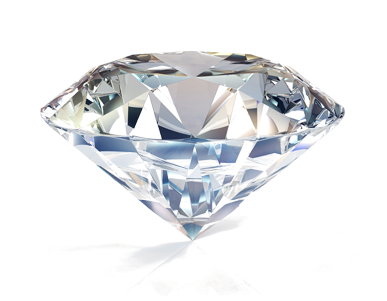
Cut: Faceting
Diamond Cut: If diamonds are the hardest material on earth, how can they be cut and faceted?
Since we see the results every day in jewelry stores, we know that rough diamonds can be cut, but only by other diamonds — usually in the form of diamond dust.
The rough diamond in the photo below is an excellent specimen of an octahedral crystal, the most common of the many shapes of rough diamond. This is called the habit of diamond crystal.
When such a crystal is fashioned into a brilliant jewelry gemstone, the diamond cutter takes the stone through many detailed steps, the most important of which are:
Cleaving
When a rough diamond is determined to be suitable, it is carefully studied for every detail of its structure. It will then be marked and given a sharp blow with a special hammer to separate the stone into two carefully planned parts. This is a risky undertaking, and only used in rare cases since the advances in mechanical cutting devices allow even the most difficult stones to be cut with little attention.
Cutting
In most cases, a diamond will be cut with a saw blade. Since diamonds are the hardest material known (which means they cannot be scratched with any other substance), only diamonds can cut diamonds. So the diamond is securely mounted and held against a thin alloy blade impregnated with diamond dust and covered with linseed oil. As the blade turns, it carries small particles of new diamond dust which sticks to the oil and continues the process until the entire diamond is split in two. This can take several days for a diamond over 1 carat or more.
Bruting
After a diamond is the height and width desired, it is crudely shaped into the round or other shape by rubbing it against another diamond on a high-speed lathe specially designed for the purpose. The bruter takes the rough from an octahedral shape to a more rounded shape in the case of many round brilliant diamonds.

Faceting
Then the long and precise process begins to create the many facets that you have seen on diamonds in stores. Each facet is created by grinding the diamond on a horizontal blade as it spins with diamond dust and linseed oil, similar to the cutting blade.
First, the large facet at the top is ground until level and smooth. Then the major facets are created on the bottom (called the pavilion), followed by the large facets on top (called the crown). Then the pavilion facets are refined into more facets, followed by the crown facets. The final touch is often the tiny flat facet at the point of the pavilion, called the culet.
The finished round brilliant diamond, for instance, will have 58 facets, including the tiny culet and large table facets.
Each step in this delicate process is generally carried out by a specialist who spends many years in apprenticeship to accumulate the great skill required. Every tiny mistake can risk a gem worth thousands of dollars. Only experience can safeguard nature’s treasures and bring out the true beauty of a diamond.