
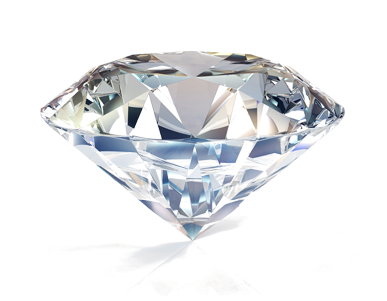
Diamond Clarity

Diamond Clarity: What are the
different diamond clarity grades and what do they mean?

Clarity is one of the two best-known
factors in diamond pricing, along with color. While the color
does affect a diamond's appearance, obvious inclusions (often
called "flaws") may distract your recipient's eye from
a stone's overall beauty. We usually recommend diamonds without
inclusions or flaws that are visible to the naked eye. This avoids
inadvertent negative feedback from friends and ensures the wonderful,
lifelong enjoyment of your diamond.
To achieve this, stay
well above the I-1 clarity grade. Clarity grades of SI2 or above
are defined as flawless to the naked eye, but SI1 is safer in
larger sizes. It's not necessary to go all the way up to IF (internally
flawless) to get a beautiful diamond. From SI1 and above, diamonds
will appear the same to the naked eye, differing only in the
other factors of the 4 Cs: including Carat weight, Color
and Cut.
Clarity greatly varies
from one diamond to another, and no two are exactly alike. The
Gemological Institute of America established standardized clarity
grades for the diamond trade which are now used worldwide among
dealers to help in trading and valuation.
The following chart
gives an idea how each grade might look under a 10x loupe microscope:

Clarity Grades
Below are some simplified
definitions of the various clarity grades set by the Gemological
Institute of America (GIA). For a comparison with other grading
systems used in other countries, go to the clarity comparison chart.
FL = Flawless -- no internal or external inclusions
of any kind visible under 10x magnification to a trained eye,
the most rare and expensive of all clarity grades
IF = Internally Flawless -- no internal inclusions
visible under 10x magnification to a trained eye, but there may
be some tiny external irregularities in the finish
VVS-1 = Very Very Slightly Included 1 -- usually just
one tiny inclusion visible only to a trained eye under 10x magnification
VVS-2 = Very Very Slightly Included 2 -- tiny inclusions
visible only to a trained eye under 10x magnification
VS-1 = Very Slightly Included 1 -- very small inclusions
visible with 10x magnification
VS-2 = Very Slightly Included 2 -- several very small
inclusions visible with 10x magnification
SI-1 = Slightly Included 1 -- small inclusions visible
with 10x magnification
SI-2 = Slightly Included 2 -- several small inclusions
visible with 10x magnification
I-1 = Included 1 -- flaws that are visible to the
naked eye
I-2 = Included 2 -- many flaws clearly visible to
the naked eye that also decrease the brilliance
I-3 = Included 3 -- many flaws clearly visible to
the naked eye which decrease the brilliance and compromise the
structure of the diamond, making it more easily cracked or chipped
NOTE: We feel that diamonds of clarity
grades I-2 or I-3 (Imperfect 2 and Imperfect 3 as described by
GIA) are not ideal as a representation of the bond of eternal
love. Therefore, we do not recommend diamonds of these clarity
grades for engagement rings.
WARNING:
Knowing the 4 Cs is NOT enough to price a diamond accurately.
At least 13 factors
affect diamond value, including fluorescence, table percentage,
symmetry and other crucial details. However, the 4 Cs are a good
place to start, and you will need to know these before you can move on.
Getting Tired Yet?
If you want to speed up the process, and get right to the prices, you can jump to my Diamond Pricing Tutorial, but I recommend continuing, because it is best to have an understanding of the 4 Cs at least, and beyond that if you want to really do the job right. If you want to understand all the details from any certificate, please keep on the path. The only other way to speed things up, is to jump right to a good local or online jeweler that can help you by showing you diamonds in person or talk you through the details over the phone. If you cannot find a good jeweler, we rate the top dealers for you.

Robert Hensley
President
Diamond Helpers